If you’ve been told AI is going to replace SEO, don’t throw out your SEO strategy just yet.
The fundamentals of good SEO haven’t disappeared. Google still needs to understand what your business does. Your website still needs technically sound foundations, useful content, clear page structure, relevant search terms, authority, and a good user experience.
But something important has changed.
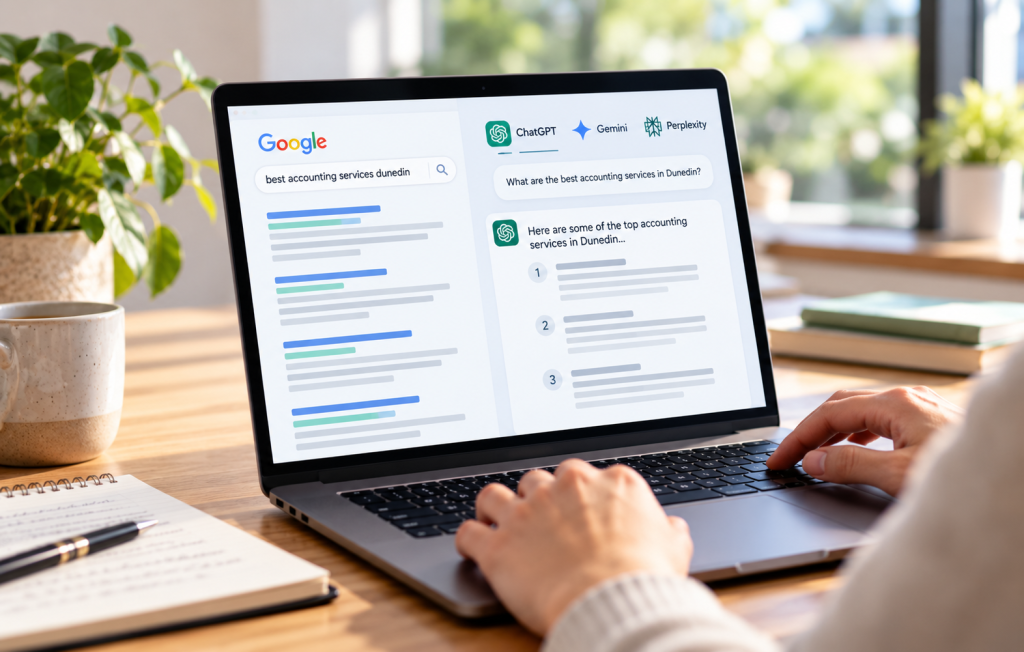
People no longer have to search Google, open several websites, compare the information, and work out the answer themselves.
Increasingly, they can ask ChatGPT, Gemini, Perplexity, or another AI platform a question and receive an answer immediately.
That creates a new challenge for businesses.
It’s no longer enough to think about where your website ranks in Google. You also need to think about whether AI platforms can understand your business and your content well enough to use your information when answering a question.
SEO and AIO aren't two completely separate things
There is a growing collection of acronyms around AI search: AIO (AI Optimisation), AEO (Answer Engine Optimisation), GEO (Generative Engine Optimisation), and undoubtedly more will follow.
It would be easy to assume this means businesses need to abandon SEO and start again.
They don't.
Much of what makes a website useful to AI platforms is also what makes it useful to search engines and, importantly, to people.
Good SEO has always been about helping search engines understand that your website is a relevant, credible source of information.
That remains important.
The difference is that we now also need to consider how easily individual pieces of information can be found, understood, and used outside the context of the entire webpage.
Think beyond the webpage
Traditional SEO has tended to focus heavily on individual pages.
What is this page about? Which search terms should it rank for? What is its title? What other pages should link to it?
Those questions still matter.
But AI platforms don't necessarily consume information in the same way a person reads a webpage from top to bottom.
Clear, self-contained pieces of information become important: an explanation, definition, comparison, process, answer, service detail, location, price range, qualification, or fact.
For example, a paragraph saying:
"We provide tailored solutions designed to meet the unique needs of every client." tells an AI system almost nothing.
Frankly, it doesn't tell a potential customer much either.
Compare that with:
"Cre8ive Marketing provides SEO and AI Optimisation services and training for New Zealand businesses, including keyword research, technical SEO, website content optimisation, local search optimisation, and improving website content for AI-driven search."
There is far less ambiguity about the business, what it provides, and who it serves.
Specificity has become even more valuable.
 Your website needs to answer real questions
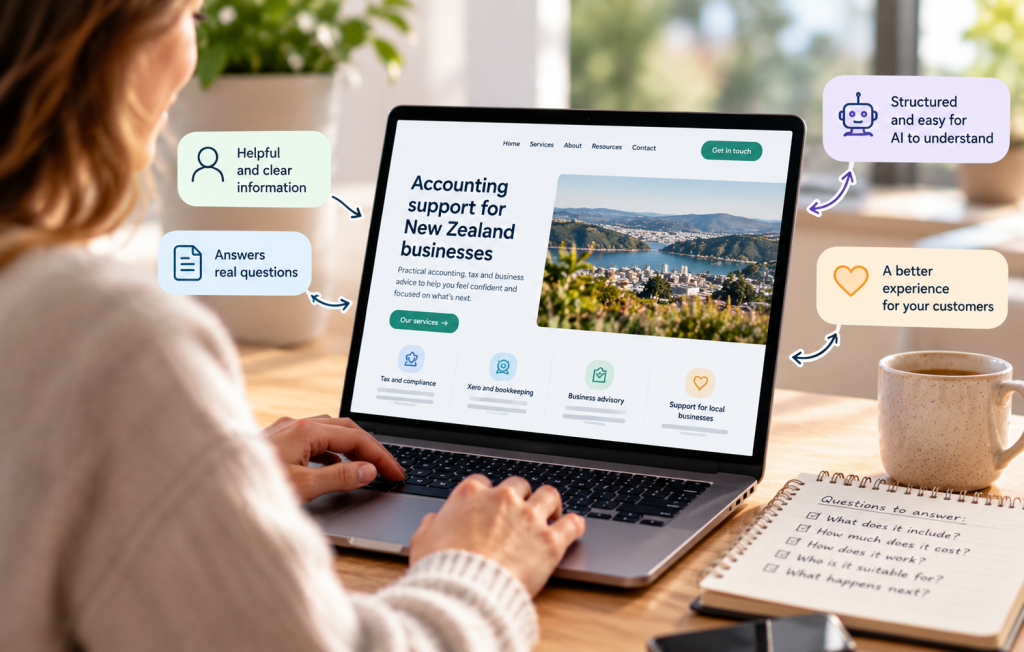
This is where businesses can get caught up chasing keywords rather than thinking about what their customers actually want to know.
Consider the questions someone might ask before choosing your business:
- What does this service actually include?
- How much does it cost?
- Who is it suitable for?
- How does the process work?
- What is the difference between two options?
- How long does it take?
- What happens next?
- What experience does the business have?
- Does it service my location?
- What evidence is there that it knows what it's talking about?
Those questions aren't just FAQ material.
They can become service-page content, supporting articles, case studies, comparisons, explanations, and genuinely useful resources.
That gives potential customers better information while also providing search engines and AI platforms with much clearer information about your business and its expertise.
Context matters more than stuffing in more keywords
One mistake we're likely to see with AIO is businesses treating it like old-fashioned SEO: find some new "AI keywords" and insert them throughout the website.
That's missing the point.
AI systems need context.
If you're an accountant, for example, it isn't enough for your website to repeatedly say "accountant Dunedin".
Your content should help establish the relationship between your business and the subjects you genuinely know about: GST, provisional tax, Xero, business structures, cashflow, payroll, small-business accounting, and the particular industries or types of clients you work with.
The aim isn't to mention everything or stuff pages with related terminology.
It's to build a clear network of meaning around your business and its genuine expertise.
AI needs to understand relationships, not just words
This brings us to entities.
An entity is an identifiable thing: a business, person, organisation, service, product, place, or topic.
Search engines have been developing their understanding of entities and relationships for years. This way of thinking is also useful when optimising content for AI-driven search because it moves us away from simply asking, "Which keyword should we put on this page?"
Instead, we start asking:
Who are you? What do you do? Who do you do it for? Where do you provide it? What subjects are you genuinely knowledgeable about?
One method we use when reviewing content is triple semantics.
Despite the technical-sounding name, the principle is straightforward. It looks at information as a relationship between three things:
Subject → relationship → object
For example:
Cre8ive Marketing → provides → SEO and AI Optimisation training
Cre8ive Marketing → works with → New Zealand businesses
SEO → improves → organic search visibility
Google Business Profile → supports → local search visibility
These aren't sentences we would simply repeat throughout a website.
Instead, the principle helps us identify whether the content makes important relationships sufficiently clear.
Those relationships can then be reinforced naturally through page copy, headings, service descriptions, internal links, FAQs, author information, structured data, and supporting content.
The objective isn't to write robotic content for AI.
Quite the opposite.
Write clearly enough that a person — or a machine — doesn't have to guess what you mean.
Your website isn't the only source that matters
What you say about yourself is only one part of your online presence.
Search engines and AI platforms can encounter information about businesses across the wider web: Google Business Profiles, review platforms, business directories, industry websites, media coverage, YouTube, social profiles, and other credible sources.
This makes consistency important.
If your website says one thing, your Google Business Profile says another, your LinkedIn page hasn't been updated for five years, and there is very little information about your business elsewhere online, you're making it harder to establish a clear and consistent picture of who you are and what you do.
Reviews, third-party mentions, citations, links, and genuine expertise demonstrated elsewhere aren't new SEO concepts.
But they shouldn't be ignored when considering visibility in AI-driven search either.
Don't optimise for AI at the expense of people
There is an obvious danger with all of this.
As businesses scramble to make their websites easier for machines to understand, we could end up with websites written primarily for machines.
We've been here before with SEO.
Pages stuffed with keywords weren't pleasant to read and rarely made businesses sound credible.
The same principle applies to AI optimisation.
Don't create hundreds of thin FAQs because you've heard AI likes questions and answers. Don't fill every page with repetitive definitions. And don't use AI to churn out dozens of generic articles that add nothing useful to what is already online.
Your website ultimately needs to persuade a person to trust you, contact you, book, visit, or buy.
If your AIO work makes the website worse for them, you've got the priorities backwards.
What should businesses actually do about AI search?
For most small businesses, we wouldn't recommend treating AI Optimisation as an entirely separate marketing exercise.
Start by getting the foundations right.
Make sure search engines can crawl and understand your website. Know what your customers are searching for. Build strong service pages. Answer their important questions properly. Make your experience and expertise clear. Optimise your Google Business Profile. Develop useful supporting content where there are genuine gaps. Build authority beyond your own website.
Then look at the same website through an AI-search lens:
- Can an AI system clearly understand who you are, what you do, where you do it, who you help, and what subjects you have expertise in?
- Are important answers buried inside long or vague pages, or are they clear and easy to understand?
- Does your content establish clear relationships between your business, services, location, customers, and areas of expertise?
- Do other credible sources reinforce what you're saying about your business?
Those are far more useful questions than simply asking:
"How do I rank in ChatGPT?"
The goal hasn't really changed
SEO has always been about becoming a relevant and trusted answer when someone is looking for something your business provides.
That hasn't changed.
What has changed is where people ask the question and how the answer gets delivered.
A traditional Google search may present a page of search results.
An AI platform may synthesise information from multiple sources into an answer before the user ever visits a website.
Businesses therefore need to think beyond rankings and consider whether their information is clear, specific, credible, well-structured, and easy for both search engines and AI platforms to understand.
SEO still matters. But the search environment around it has changed.
And your SEO strategy needs to change with it.
Learn how to improve your own SEO and AI search visibility
At Cre8ive Marketing, we provide practical SEO and AI Optimisation (AIO) training for New Zealand businesses that want to understand and manage more of their own online visibility.
Our Improve Your Website's Online Visibility: SEO, AI Search & User Experience training uses your own website as the practical learning environment rather than teaching SEO in the abstract.
We cover keyword and search-intent research, on-page and technical SEO, website content optimisation, semantic relevance, entities and entity relationships, Google Business Profile optimisation, AI-driven search, Google Search Console and Google Analytics, as well as user experience and conversion fundamentals.
The aim isn't to hand you a generic SEO checklist.
It's to give you the knowledge to identify what your website needs, prioritise the work, make improvements, measure performance, and continue adapting as traditional and AI-driven search evolves.